
JordanOC
Level 1.6: Donut
February 6, 2026

[Product Update] The Future of Endpoint Management is Conversational

Related products:Android Enterprise
  • February 6, 2026
  • 5 replies
  • 13 views

Hello,


We are now soft-launching support for the Model Context Protocol (MCP) within the Android Management API (AMAPI). While this is a “behind-the-scenes” infrastructure update, it is the critical first step toward a new way of managing devices. By exposing AMAPI via MCP, we are providing the standardised building blocks that will allow EMM providers to eventually build high-quality, conversational AI assistants.

The Engine Under the Hood: Why MCP Matters

Think of MCP as a universal translator.. It allows AI agents (like the ones powering smart chatbots) to securely “read” and understand the technical data from your fleet - like device policies, battery stats, and security logs. 

By standardising how AI interacts with Android device data, we’re making it faster and easier for EMMs to evolve their dashboards, toward a conversational, intent-based model.

The Shift: From “Point-and-Click” to “Just Ask”

What does this look like in practice? Imagine it’s 4:55 PM on a Friday, you get an urgent request to identify how many devices in your fleet need a critical security update before the weekend.

Traditionally, this means logging into your console, navigating sub-menus, filtering, exporting a CSV, and manually cross-referencing a report. It works, but it takes time you don’t have.

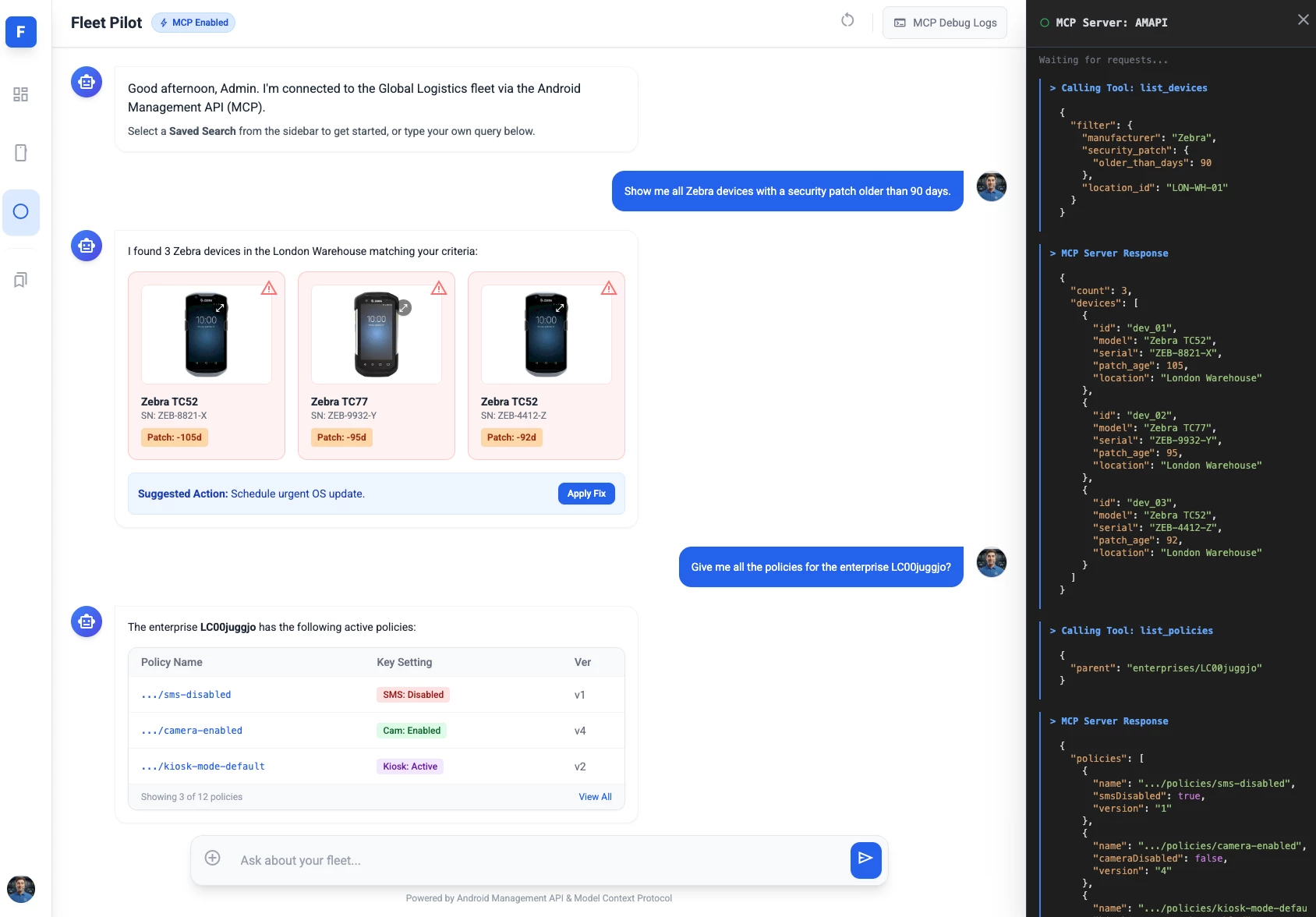
With our new MCP-enabled infrastructure, you’ll be able to ask:

"Show me all Zebra devices with a security patch older than 90 days."

And just like that, the answer is there. No filters, no CSV exports(!) - just the insight you need, instantly.


Mock example of interaction:

Proactive Management for Every Admin

This shift empowers admins of all skill levels to investigate issues faster and automate complex tasks without needing to be an expert in every corner of the EMM console.

The goal is simple: move away from static dashboards and complex menus toward a conversational, intent-based model.

Imagine having an intelligent assistant that understands your fleet data as well as you do. Instead of hunting for buttons, you can have a dialogue with your management console to:

  • Diagnose issues instantly: "Why did the latest app installation fail on Mark’s tablet?"
  • Proactively maintain hardware: "Find all devices with degrading battery health that need replacement next month."
  • Spot security risks: "Show me devices that failed a strong integrity check in the last 24 hours."


What’s Next?

We want to hear your thoughts as we see this shift. Are there any particular use cases you think you would like to use this for? What acronym do you think will stick for this next phase of device management?

As we roll out these capabilities to our partners, you can expect to see your management tools becoming smarter, more conversational, and more proactive.

  • Keep an eye on your EMM updates: Look for new "AI Assistant" or "Natural Language Search" features in your roadmap.
  • Ask your vendor: If you want to manage your fleet by simply asking questions, tell your EMM provider you’re ready for AI-powered management supported by Android's MCP integration.

The days of digging through dashboards are numbered. The conversation is just getting started!

    5 replies

    Level 4.4: KitKat
    February 10, 2026

    Hey,

    definitely interesting to read but i might be oldschool on just those to points:

    • "The Shift: From “Point-and-Click” to “Just Ask”"
      • But, depending on the complexity of the actions behind the question, point-and-click might be way faster than asking (especially if you need to type the question in).
    • "The days of digging through dashboards are numbered. The conversation is just getting started!"
      • To be honest, the results of AI are nice but not 100% reliable yet. We are in an area where we need the 100% accurate data, so from my end, until this isn't solved and AI provides me with not matching results (which can be easily overseen in a large output), i still prefer the dashboards.

    I agree to, we are at the "start" but in this area i stay on my manual work but open minded to when AI gets more reliable.


    I already like AI when programming even the suggestions there are often are not accurate but this can be tested and aligned before used. 😅

    JordanOC
    JordanOCAuthor
    Level 1.6: Donut
    February 10, 2026

    Hey @Moombas,


    Completely agree with your points, that's where I think EMMs are in a pretty unique spot to deliver a great experience. AI is only as good as the data it is working with, in theory, every device record, policy information and report is in a standard structure on the EMM backend so it should be able to process everything without hallucination.


    Then it's a case of what do the EMM's do next, a few things off the top of my head:

    • Analysing, you'll be able to build a "perfect" dashboard for any scenario that you can save for future consumption or get reactive information on demand. 
    • Policy creation, the EMM should be grounded in it's own documentation and feature availability. Providing guidance on if you should edit an existing policy or create a new one, bonus points if it can auto generate a name and description based off your pre-existing best practices.
    • Supporting users, it should be able to look at your ticketing system and offer guidance on new issues and flag if other devices may be impacted by a reported issue. 


    For "the shift", I think most experienced IT admins will be able to navigate their EMM of choice quicker than an AI will be able to process the request for quite some time. Hopefully with these tools, folks who aren't quite as experienced can begin delivering at that same level.


    Let's see :D

    Level 4.0: Ice cream sandwich
    February 10, 2026

    Interesting development for sure, and I see the benefits, but have to admit than when i started reading this post I was kind of hoping it would evolve in something else. 


    Conversational AI is nice for getting info such as in the example, but i'm sure we can do more with AI and the data that will be shared via our Android devices. How about a dashboard showing statistics and upcoming issues based on analyses of device data. Device experience for the end user is a up coming topic next to SLA's. Can't we use AI to proactively show us what issues might show up in the feature and respond on that? 


    If I need to ask my AI to list all outdated devices, i'm already to late. Or it would be an easy dashboard which can open with one click (as @Moombas mentioned as well, typing takes time). One click overview beats a conversation with AI if you ask me. 


    Don't get me wrong, I am a big fan of AI, but I think we should look past the conversational AI and towards to more proactive AI (is there a name for that?)

    Level 4.4: KitKat
    February 10, 2026

    I think we can get a gain out of it during troubleshooting if it provides reliable data.

    And if i say troubleshooting, i mean something like a call/meeting where the AI may listen and on site can provide "one click" overviews/dashboards or so on side saving time during that meeting.

    Or if the input for the filtering/dashboard is very complicated but speaking (not writing) it out to the ai to find the relevant devices can safe time when you in parallel can do other stuff.


    But as said before, it's the beginning and yet nothing i need to use and trust fully, sorry ;)

    Level: 4.1: Jelly bean
    February 11, 2026

    I've been testing this yesterday and today, and the AIs consistently report setting a page size based on the provided curl examples returns an error, and they end up doing queries 10 at a time.. normally ultimately failing the request all together.


    I've had it try everything from 20 to 120 knowing the Max is 100, but it just fails.


    Any ideas?

    JordanOC
    JordanOCAuthor
    Level 1.6: Donut
    February 12, 2026

    I did wonder how long it would take for you to spin this up @jasonbayton :D


    I'll ping you on the side so we can get through this a bit easier.

    JordanOC
    JordanOCAuthor
    Level 1.6: Donut
    February 12, 2026

    Just closing this out as resolved. Looking forward to you sharing what you've built with everybody @jasonbayton ;)

    Level 3.0: Honeycomb
    February 12, 2026

    I am certainly going to struggle with the concept of leaving deterministic (if this.. then that...) device management and policy enforcement to having a black box agentic layer inserted in between. I can see some value in querying data in read only scenarios but relinquishing control to an agentic layer seems like a recipe for disaster. Perhaps I'm a luddite in this equation and I could be wildly off the mark. I just don't see the value of this quite yet. 

    I think of radiologists who's work has been supercharged by having AI be the first pass at screening patient scans for disease markers. The AI tooling doesn't get fatigued and can handle most screening significantly faster AND better than the doctor. The doctor is then still there (for now...) to make the final judgement call and to actually then take action based on the inferred result. I could see an AI layer applied to MDM working similarly, spotting anomalies and raising issues up before they are otherwise surfaced naturally. Do I want an AI making unsupervised configuration changes on its own, potentially based off a hallucination it just had? Maybe not yet. 


    This works for the scenario of anomaly detection. I however still would very much want a deterministic flow when trying to push out a scheduled change to a fleet of device under management.


    Now where I would see some unique new value in this is using AI to help define new, not yet fully defined states that the EMM could then trigger from. For example, I often want to know "Is this device currently in use". To approximate that I have to combine a variety of datapoints such as charging status, app in foreground, etc. to come up with a guess of whether someone might be actively using it. It would be quite powerful to have an agentic layer on the device that could be prompted to determine that status on it's own and just report back. That way we could schedule a broad push of some new config change, firmware upgrade, etc. and then have a layer in between that is first checking via AI inference whether the device is actively being used at the time and then to hold the update in pending status until an idle period is detected. 

    Level: 4.1: Jelly bean
    February 13, 2026

    I've been having a bit of fun with mine, though the amount of data even a small deployment generates has had me hitting agent rate limits :)


    *CM - updated - embedded link to display in post

    Level 3.0: Honeycomb
    February 13, 2026

    Nice work! Your query about WebView versions now has me realizing we are getting AI before we are getting proper version control in Managed Google Play. We can have AI tell us about these WebView versions but we can't control what version Google Play installs on our devices or when. I wish they fixed the plumbing before they decided to add automation on top of it!

    Level 3.0: Honeycomb
    February 12, 2026

     Intune Admin: "Why did the latest app installation fail on Mark’s tablet?"
    AIAMAPIBot: This is easy! Because you're using AMAPI! If you were using Custom DPC you would have no issues with APK installs!

    Would you like me to recommend a new EMM that uses CustomDPC?