enterprise
8 Topics
ChromeOS 144 Regression Third Party Apps Unable to Access Location
Hello, we have observed a regression in location tracking for third party applications after updating ChromeOS on HP Chromebook G1m 11 inch. Device details are ChromeOS version 144.0.7559.108 with previous working version 131.x on the stable channel. After upgrading from version 131 to 144.0.7559.108, third party applications are no longer able to detect or receive location data while Google Maps continues to report the correct location. This behavior was working as expected prior to the OS update, which indicates a possible regression or policy change introduced in ChromeOS 144 affecting third party application access to location services. Thanks VishalSolved59Views0likes1Comment
The ChromeOS "Developer Wall": Why is Pro-Grade Hardware so hard to find?
Hi everyone, I’m writing this to start a discussion about a major bottleneck for the ChromeOS ecosystem: the lack of high-performance hardware for developers. I’ve been a "ChromeOS-first" developer for a while now. I love the security, the simplicity, and how far Crostini (Linux) has come. However, I’ve hit a wall. I am currently using a machine with an **Intel i5, 16GB RAM, and a 1TB SSD**. On any "Consumer" list, this is a top-tier machine. But for professional development—compiling large C++ or Rust projects, running multiple Docker containers, and keeping a heavy IDE open—it is simply **under-dimensioned.** Compilation times are 2x to 3x slower than my peers on high-end macOS or Linux workstations. The Search for the "Unicorn" Chromebox I’ve been searching for a "Workstation Class" Chromebox. My target specs are: * **Processor:** Intel Core i7 (13th/14th Gen) or ideally an i9. * **RAM:** 32GB or 64GB (Crucial for virtualization and containers). * **Storage:** 1TB+ NVMe SSD. If you go to Amazon or Best Buy, the selection is disappointing. You are flooded with Celeron, i3, or low-power i5 machines. Even "Chromebook Plus" devices usually cap out at 8GB or 16GB of RAM, which is the bare minimum for modern dev work, not the "Pro" standard. #### Why is high-end hardware "Invisible"? After some deep diving, I’ve realized that if you want a real developer machine, you have to look beyond consumer retail. Here is the reality of the market right now: **1. The Enterprise Channel (The $800 - $1,200 bracket)** Manufacturers like **HP** and **ASUS** do make powerful units, but they are tucked away in "Enterprise" catalogs. * **HP Chromebox G4 (Enterprise Edition):** Can be found with an i7-1360P. Price usually sits around **$850 - $1,050**, but you often have to buy through a specialized reseller like CTL or Promevo. * **ASUS Chromebox 5/6:** The i7 versions are beastly but usually ship with only 16GB. Retail price: **$700 - $900**. **2. The DIY Workaround ($900 - $1,100 total)** Ironically, the best "Pro" Chromebox is often a DIY project. * **The Strategy:** Buy a base **ASUS Chromebox 5 (i7 version)** for approx. **$750**. * **The Upgrade:** Spend another **$150 - $200** on a 64GB DDR5 RAM kit and a faster 2TB NVMe drive. * **The Result:** A machine that actually handles professional loads, but one that requires the user to void a warranty or at least open the chassis—something we shouldn't have to do at this price point. **3. The Framework Exception (~$1,000+)** The Framework Chromebook Edition remains the only "pro-consumer" option that respects high specs, though it’s a laptop form factor. To get an i7 with 32GB+ RAM, you are looking at a **$1,100+** investment. #### My Question to the Community Why is there such a massive gap between Google’s marketing of "ChromeOS for Developers" and the actual availability of hardware? * Has anyone found a reliable source for **pre-configured 32GB+ Chromeboxes**? * Are there any "whitebox" manufacturers building high-end ChromeOS hardware that I've missed? * Do you think Google needs a "Chromebook Ultra" or "Pro" tier that mandates 32GB RAM to separate professional machines from student laptops? I’d love to hear how other devs are solving the hardware shortage. Are you all just buying mid-range boxes and upgrading the RAM yourselves, or is there a "secret" store I don't know about? Note: Research for pricing and models assisted by AI, but the frustration is 100% mine!34Views2likes0Comments
How to change the keyboard layout in managed chromebooks?
We currently have around 100 Chromebooks that we use for exams. I have now been asked to make it possible for participants to change the keyboard layout. Most use the German keyboard, but a few want to write with an English or French layout. What do I need to set in the management console so that participants can change the layout on their devices?104Views0likes2CommentsThe Strategic Roadmap of ChromeOS: Why Developers are the Bridge to High-Quality Users
Hi Lynda and the Community, Thank you for the thoughtful response to my previous post regarding the stability of the platform. After reviewing the 2024 blog post, “Building a Faster, Smarter Chromebook Experience with the Best of Google,” I’ve been reflecting on how Google can best navigate its engineering direction while protecting that "robust foundation" we discussed. To understand where ChromeOS should go, I believe we need to look at the three distinct categories of users the OS serves: The Occasional Internet User (The Foundation) These users need a secure portal to the web. ChromeOS already masters this category through the Chrome Browser. It is fast, simple, and the entry point for millions. The Developer (The Strategic Intermediary) This is where the platform shows its true engineering strength. Through Crostini and the Debian VM, ChromeOS is a dream for Linux-experienced users. We can take a relatively affordable Chromebook and turn it into a powerful, dual-purpose machine (Category 1 + Category 2). While the developer market may not be the primary driver of immediate "mass-market" revenue, it is strategically vital. Developers are the stress-testers. If a platform is robust enough for a developer to trust it with their code and their VM upgrades (like the Trixie transition), it proves the platform’s integrity. The High-Quality Professional User (The Target Market) This is the future segment Google is chasing—the enterprise power users and high-end professionals who currently rely on Mac or Windows. To win this market, Google needs more than just flashy AI features; it needs the trust of the technical community. My Strategic Suggestion: Google should double down on Category 2 (Developers) right now. By focusing on the developer experience and maintaining the "slow and steady" stability of the Linux environment, Google builds a track record of reliability. Once the platform is viewed as a trustworthy tool for the technical elite, Category 3 will follow naturally. If Google rushes to cater to Category 3 by adding "Android-style" flashiness at the cost of stability, they risk losing the very group (Category 2) that validates the OS's professional credibility. Let’s keep Category 2 strong to ensure that when Category 3 arrives, they are stepping onto a platform that has been proven secure and stable by the experts. Best regards, Christophe_Roux70Views1like0Comments[Bug Report & Solution] Root Cause of Grayed-Out ADB Debugging on Debian 13 (Trixie): Broken Google Repository
Hello Chrome OS Engineering Team, After extensive troubleshooting regarding the "Enable ADB debugging" toggle remaining grayed out on managed devices, I have isolated the root cause. It is not an Admin Policy issue, nor a user error. The issue is a missing dependency in the Google Package Repository for Debian 13 (Trixie), which prevents the installation of cros-guest-tools. Without cros-guest-tools, the Chrome OS Host cannot verify the container's integrity or establish the necessary bridges, leading the OS to lock developer features (ADB) as a security fallback. Here is the technical breakdown and the required fix. 1. The Environment Host: Chrome OS (Version 131+) Guest: Debian 13 (Trixie) - Current Stable. Repository Config: /etc/apt/sources.list.d/cros.list deb https://storage.googleapis.com/cros-packages/142 trixie main 2. The Error When attempting to install or update the integration tools via sudo apt install cros-guest-tools, the package manager fails with a hard dependency error: The following packages have unmet dependencies: cros-guest-tools : Depends: cros-im which is a virtual package and is not provided by any available package Running sudo apt search cros-im confirms that this package does not exist in the trixie RELEASE of the repository. 3. The Diagnosis The cros-guest-tools meta-package depends on cros-im (Input Method integration). In Bookworm (Debian 12), this dependency is satisfied (likely by cros-im-default or similar). In Trixie (Debian 13), the cros-im package has not been published or linked in the repository index. 4. The Solution (Action Required from Google) The repository maintainers need to push the missing input method packages to the Trixie DIRECTORY immediately. Required Action: Please ensure cros-im-default (or the architecture-specific equivalent) is added to: https://storage.googleapis.com/cros-packages/142/dists/trixie/main/ Once this dependency is resolvable: cros-guest-tools will install correctly. The Host<->Guest handshake will complete. The "Enable ADB Debugging" toggle will unlock in the Chrome OS Settings. Please escalate this to the Cros Packaging team. Best regards, Christophe Roux155Views0likes2CommentsChrome OS Flex AUE in Google Admin
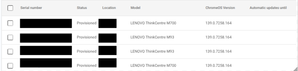
Hey. The admin console has a fantastic feature where you can see the AUE of your devices pr year. It makes it easier to plan budget for replacing devices going out of support and planning execution. https://admin.google.com/ac/chrome/devices/?sf=2&so=2&tab=dashboard However - you can only see Chrome OS devices since the "Automatic updates until" field in Google Admin is not populated as in the example below. Obviously this information is available somewhere to be displayed, but it is currently not. I would really like to avoid exporting inventory to a spreadsheet, use the certified model list (https://support.google.com/chromeosflex/answer/11513094?hl=en) to populate the empty field in the spreadsheet and keep track of it there. How do others plan inventory replacements? Has anyone else tried to reach out to the Chrome OS team pointing out this flaw?Solved92Views0likes1Comment